How to Use AI in Medical Transportation: Top Use Cases
AI is becoming a standard tool in medical transportation. Explore practical use cases for NEMT providers: route optimization, ETA prediction, and smarter trip assignment.
Quick answer
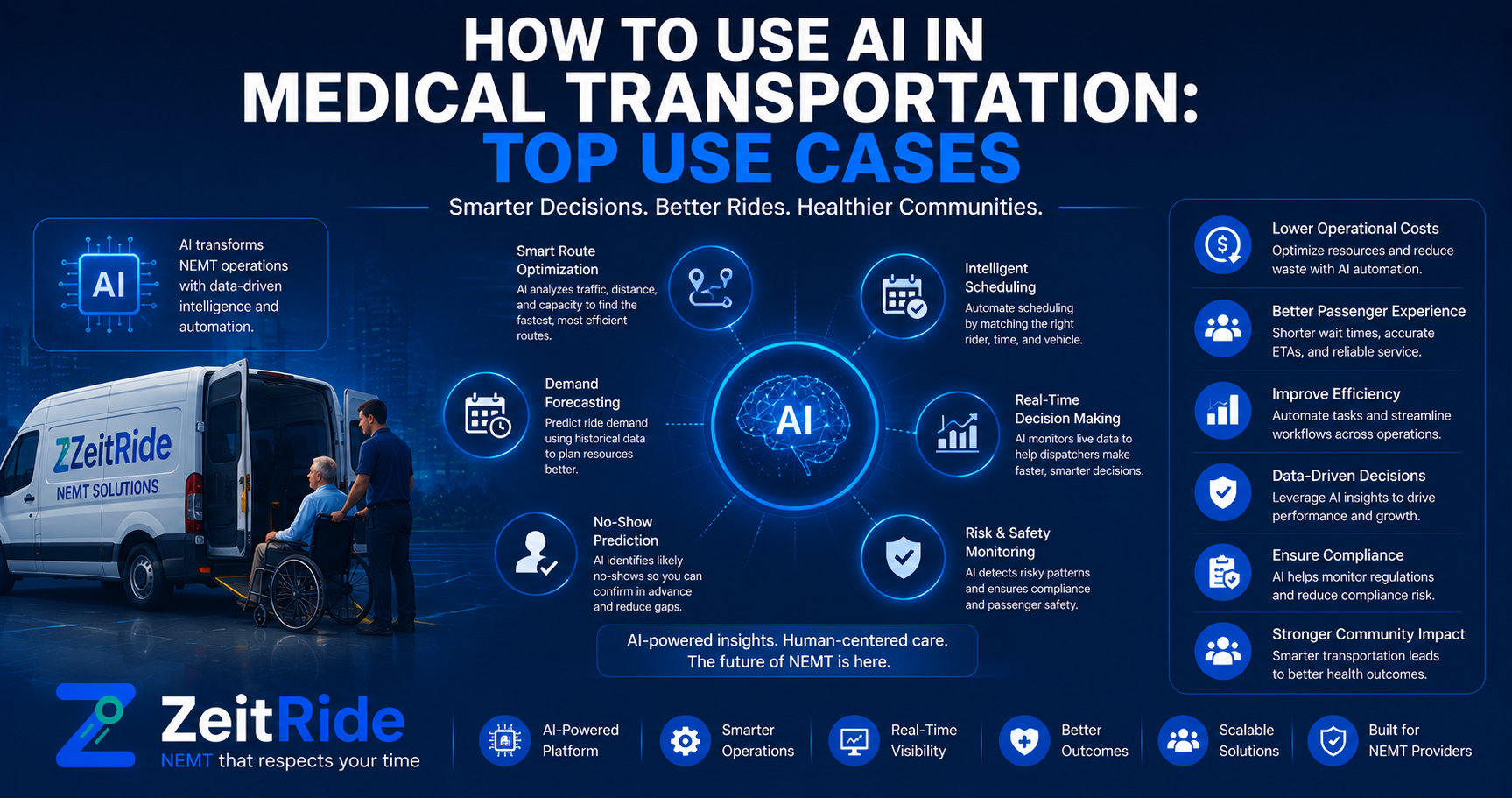
AI is used in NEMT for route optimization (sequencing trips to minimize miles and time), dynamic trip assignment (matching drivers to trips based on proximity and availability), ETA prediction (accounting for traffic and appointment variance), multiload optimization (grouping compatible passengers), and no-show risk scoring. These AI capabilities reduce per-trip costs, improve on-time performance, and enable dispatchers to manage larger fleets.
ZeitRide Team
NEMT Operations Expert
Why AI Matters in NEMT Operations
Non-emergency medical transportation is a scheduling and logistics problem with unusually high constraints: tight pickup windows, passenger mobility requirements, vehicle capability matching, multi-broker authorization flows, and real-time variability as appointments run over or under. These are exactly the conditions where AI adds value—handling computations that are too complex and too time-sensitive for manual processes.
AI in NEMT isn't theoretical anymore. Route optimization, dynamic assignment, and predictive analytics are built into leading NEMT platforms and used daily by thousands of providers. Understanding where AI applies—and how to evaluate vendor claims—helps you make better purchasing decisions and better operational choices.
Route Optimization: The Highest-ROI AI Application
Route optimization is the most mature and highest-ROI AI application in NEMT. Given a set of trips with pickup windows, destinations, vehicle types, and driver start/end locations, a route optimization algorithm sequences and assigns trips to minimize total drive time, miles, or a combination of both—while satisfying all constraints.
In practice, this means a fleet of 20 vehicles that previously covered 1,200 daily miles through manually sequenced routes might cover 950 miles with AI optimization—a 20% fuel and time reduction. At scale, these savings are significant: fewer miles means less fuel, less vehicle wear, and more capacity without adding vehicles.
Modern NEMT route optimization runs continuously. When a trip is added, cancelled, or delayed, the optimization re-runs and surfaces updated assignments. Dispatchers see the recommended changes and can apply them with a single click rather than manually re-sequencing across a board.
Dynamic Trip Assignment
AI-powered trip assignment goes beyond simple proximity matching. It factors in driver shift hours remaining, vehicle capability (wheelchair, stretcher, ambulatory), existing trip load, break requirements, and broker authorization status. When a new trip comes in, the system scores available drivers and surfaces the best match—rather than leaving that judgment to a dispatcher managing 15 simultaneous situations.
This capability is particularly valuable during high-volume periods (morning dispatch waves) and during mid-shift disruptions (no-shows, driver breakdowns, add-on trips). The AI handles the combinatorial matching problem; the dispatcher handles exceptions and confirmations.
ETA Prediction
Accurate ETA prediction in NEMT requires more than map distance. It needs to account for real-time traffic, historical appointment completion patterns, driver behavior patterns, and facility-specific loading times. AI models trained on historical NEMT data significantly outperform simple map-based estimates for these predictions.
Better ETAs have a compound effect: passengers wait less, facilities plan better, dispatchers intervene earlier when a trip is at risk, and broker compliance scores improve. Sharing live AI-generated ETAs with facility coordinators via automated notifications is one of the highest-impact service quality improvements a provider can make.
Multiload Optimization
Multiloading—combining compatible passengers in one vehicle—is one of the most valuable efficiency levers in NEMT when used correctly. AI multiload optimization evaluates trip compatibility across pickup windows, destinations, passenger mobility needs, and travel time impact, then recommends combinations that meet service level requirements without excessive detours.
Without AI, multiloading decisions are made by dispatchers who may not have full visibility into all candidate trips simultaneously. AI optimization consistently finds combinations that humans miss—increasing vehicle utilization without degrading service quality.
No-Show and Cancellation Prediction
Some AI platforms are beginning to apply predictive models to no-show risk—scoring trips based on historical passenger behavior, appointment type, time of day, and other signals. High-risk trips can be flagged for proactive outreach (automated reminders) or pre-assigned backup capacity. This reduces wasted vehicle deployments and improves fleet utilization.
When evaluating AI claims from NEMT vendors, ask specifically: what data is the model trained on, how often does it re-optimize, what triggers a reassignment recommendation, and how are driver and dispatcher overrides handled? Strong AI implementations are tools that augment decisions—not black boxes that replace them.
Rather see it than read about it?
Bring a real route, a couple of drivers, and your current process. 15 minutes, zero pitch.